PHONE CALL · LOCATION
Delivery Driver Can't Find You? What to Say in Chinese
Ask which entrance they mean before giving your own location.
USE IT NOW
您在哪个门?我在南门。
Which entrance are you at? I am at the south entrance.
Use 南门 only if that really is your entrance. Otherwise change the location or first ask the driver to describe where they are.
Confirm the building and the entrance separately. If you missed the question, ask for a slower repeat before giving a location. A short, accurate answer is more useful than a long one you cannot explain.
Selected lines use synthetic Mandarin speech, not a human teacher or an authentic recording. Audio sources and limits →
Jump to a section
The situation
You are receiving a delivery at a residential complex. The driver is at the north entrance; you are at the south entrance. The labels and building numbers here are fictional.
- Channel
- Phone call; text can help if the driver can receive it.
- Useful starting knowledge
- Some pinyin, basic directions and the name of your actual entrance.
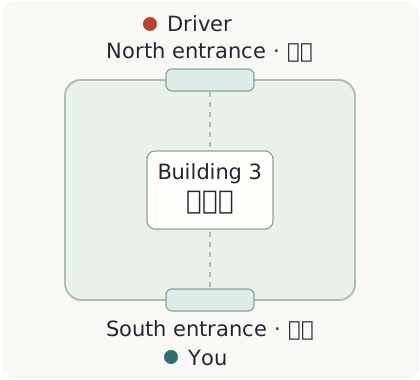
Listen to a possible call
Original teaching simulation · not a real call or message
Synthetic practice call · one voice reads both roles. Follow the four lines below. This is not a real delivery call.
Driver
您好,您的外卖到了。您在几号楼?
Hello, your food delivery is here. Which building are you in?
You
我在三号楼。您现在在哪个门?
I am in Building 3. Which entrance are you at now?
Driver
我在北门。
I am at the north entrance.
You
我在南门。请在北门等一下,我过去。
I am at the south entrance. Please wait at the north entrance for a moment; I will come over.
Building, unit or entrance?
几号楼 asks for the building number. 哪个单元 asks for the unit or stairwell section. 哪个门 asks which entrance. An apartment door is not necessarily the entrance to the complex. Repeat the location category you heard instead of answering every question with a room number.
几号楼?
Which building number?
哪个单元?
Which unit / stairwell section?
哪个门?
Which entrance?
Do not guess a question you missed.
If the call is fast or noisy, ask for a repeat. If a text message would help, ask whether they can send one; this is a request, not a guarantee that an app or driver supports it.
请说慢一点,我没听清。
Please speak a little more slowly; I did not hear clearly.
您能发条消息吗?
Could you send a message?
Use a visible landmark only if it helps.
A direction such as “south entrance” is useful when both people can identify it. Otherwise describe a visible sign or ask which entrance the driver is at. Do not send a door code, a stranger’s phone number or unrelated personal information just to practise a sentence.
CHOOSE WHAT YOU MEAN
Check their location, explain yours, or agree to meet.
If the conversation continues
They say: 我进不去。
“I cannot get in.” Agree on an accessible meeting point rather than promising access you cannot arrange.
那我出来拿。您在哪个门?
Then I will come out to collect it. Which entrance are you at?
They say: 你能出来拿吗?
“Can you come out to collect it?” If you cannot, say so and ask about another option. The alternative still needs agreement.
我现在不方便出来。可以放在前台吗?
I cannot conveniently come out right now. Could you leave it at the front desk?
FOR THIS SITUATION
Found the entrance? Agree where the delivery goes.
A correct address is not the same as an agreed handover point. If you cannot come out, ask about an alternative before telling the driver to leave the order there.
Ask before using a front desk
可以放在前台吗?
Could you leave it at the front desk?
Use this only if there is a front desk that can accept your order. Check with the desk as needed, and wait for the driver to agree. Silence does not confirm the arrangement.
Check the actual location afterward
您放在哪儿了?
Where did you leave it?
If the order has been left somewhere, ask where rather than assuming it is at your apartment door. If the answer is unclear, ask for the location in a message. Do not share access codes just to make this example work.
OPTIONAL PRACTICE
Listen for the location. Then repair a missed question.
No score, no account. You can check the explanation without choosing an answer.
Listen first: what information does the driver ask for?
Synthetic practice clip. Listen at normal or slower speed; the transcript is optional.
Read the transcript instead
您好,您的外卖到了。您在几号楼?
Hello, your food delivery is here. Which building are you in?
See the explanation
几号楼 means “which building number?” Reply with the actual building, for example 三号楼 (Building 3). The transcript is available even if audio does not work.
Your building number — ✓ Yes. 几号楼 asks which numbered building. A unit or entrance may be asked about separately.
Your delivery pickup code — Not this question. 楼 is the clue: they are asking about a building, not a code.
Which entrance you are at — That would be 哪个门. In this clip the driver asks 几号楼: which building number.
You missed the last sentence. Which reply helps you check it?
See the explanation
Ask for a slower repeat before agreeing. 对,对 can be natural when you understand, but here it could confirm the wrong place.
请说慢一点,我没听清。 — ✓ This asks for slower speech and says you did not hear clearly. You are not guessing the location.
对,对。 — This means “yes / right.” It may sound like confirmation even though you did not understand.
Keep the useful lines handy.
Copy the reply options or bookmark this page. Change the example details to match your situation.
Selected audio is synthetic. Independent language and listening review are not complete.
Sources and review limits
Published by Next Line Mandarin. Original teaching examples, not platform instructions or transcripts of real people.
Location categories, conditional directions and agreement on the handover point. Examples, conditions and explanations checked for consistency within this lesson. This is an AI-assisted editorial check, not independent language verification.
- Editorial check
- 2026-10-13 · AI-assisted consistency check
- Independent review
- Independent review pending · Chinese usage, English explanations and listening
Audio is synthetic; pinyin shows dictionary tone marks, not a transcript of every connected-speech change. A date is not a teacher endorsement. Examples suggest possible replies; they do not establish another person’s intentions.
Audio provenance and licences · Editorial method · Correction-channel status